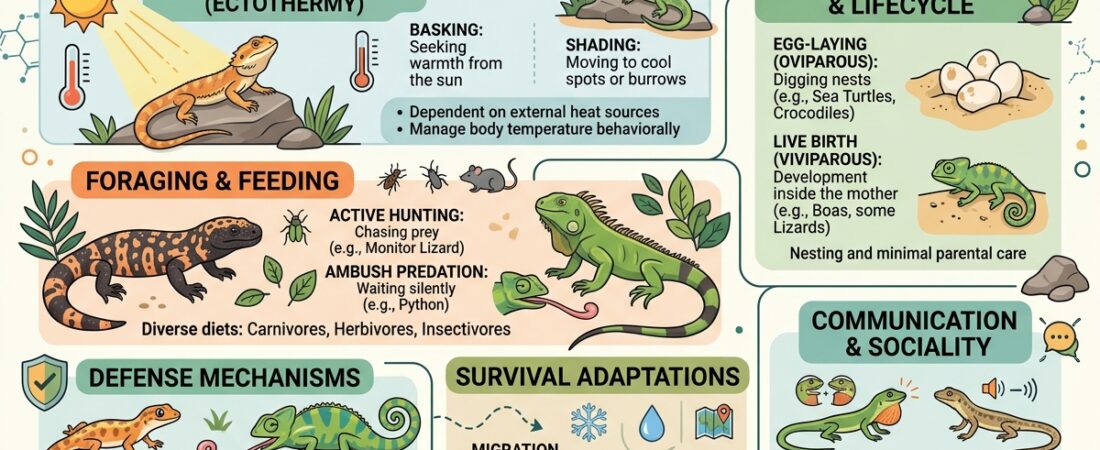
Reptiles are fascinating animals with a wide range of behaviors that help them survive in different environments. From snakes patiently waiting for prey to lizards basking in the sun and turtles returning to familiar nesting areas, reptile behavior is closely connected to their habitat, body temperature, food, reproduction, and protection from predators.
Although reptiles are often considered quiet or slow-moving animals, many species have complex behaviors. They use movement, body posture, sounds, scents, colors, and physical displays to communicate and respond to their surroundings.
Understanding reptile behavior can help us appreciate these animals and better understand their role in natural ecosystems.
What Is Reptile Behavior?
Reptile behavior refers to the ways reptiles respond to their environment and interact with other animals. Their behavior includes feeding, hunting, resting, basking, mating, nesting, defending themselves, and finding shelter.
Because reptiles are ectothermic, their body temperature is strongly influenced by the environment. This means temperature can have a major effect on their daily activities. A reptile may move into sunlight to warm itself and then retreat into shade when it becomes too hot.
Different reptile species behave differently depending on their habitat, body structure, diet, and survival needs.
1. Basking Behavior
One of the most recognizable reptile behaviors is basking. Reptiles often sit in sunlight or on warm surfaces to increase their body temperature.
Since reptiles do not produce enough internal heat to maintain a constant body temperature like mammals do, they depend on environmental heat.
Lizards may bask on rocks, branches, walls, or the ground. Turtles often climb onto logs or rocks near water to warm themselves. Snakes may stretch out in sunny areas before becoming active.
Basking is important because body temperature affects movement, digestion, and other biological processes.
Reptiles carefully balance exposure to sunlight with periods spent in shade or shelter. This allows them to maintain a suitable body temperature while avoiding overheating.
2. Feeding and Hunting Behavior
Reptiles have different feeding behaviors based on their diets. Some are predators, while others mainly eat plants, fruits, or a combination of foods.
Many snakes are ambush predators. Instead of constantly chasing prey, they may remain still and wait for an animal to come within striking distance.
Other reptiles actively search for food. Monitor lizards, for example, can travel through their surroundings looking for insects, eggs, small animals, or carrion.
Chameleons have a particularly interesting hunting strategy. They can use their long, rapidly moving tongues to capture insects from a distance.
Crocodilians may wait quietly near water before quickly attacking suitable prey.
These different strategies show how reptile behavior is closely connected to their physical adaptations.
3. Defensive Behavior
Reptiles have developed many ways to protect themselves from predators. Their defensive behavior varies greatly between species.
Some reptiles rely on camouflage. Their body colors and patterns help them blend into leaves, soil, rocks, sand, or tree bark.
Others use warning displays. A lizard may puff up its body, open its mouth, raise its tail, or change its posture when threatened.
Snakes can hiss, coil their bodies, flatten their necks, or display warning colors. Some venomous snakes use threatening postures to discourage predators from approaching.
Turtles and tortoises have another effective defense: their shells. Many species can pull their heads and limbs into the shell when they feel threatened.
Crocodilians rely on their powerful bodies, jaws, and aquatic environments for protection and hunting.
4. Communication Between Reptiles
Reptiles may not communicate in the same obvious ways as birds or mammals, but many species use signals to interact with each other.
Communication can involve body movements, visual displays, chemical signals, vibrations, and sounds.
Lizards may use head movements, push-ups, tail movements, and changes in body posture to communicate with other individuals. These displays can be related to territorial behavior, courtship, or warning.
Snakes rely heavily on chemical information. They use their tongues to collect chemical particles from the environment and transfer them to a specialized sensory organ called the Jacobson’s organ.
Some reptiles also produce sounds. Crocodilians are known for vocal communication, particularly during breeding and when interacting with young.
5. Territorial Behavior
Some reptiles defend specific areas against other members of their species. This is known as territorial behavior.
A territory may contain important resources such as food, shelter, basking locations, or access to potential mates.
Many lizards are particularly known for territorial displays. A male may perform visual movements or adopt a threatening posture when another male enters its area.
If displays do not discourage an intruder, physical conflict may sometimes occur.
Territorial behavior helps reptiles control access to valuable resources and can influence their opportunities to reproduce.
6. Mating Behavior
Reptile mating behavior varies considerably between species.
During the breeding season, males may use visual displays, chemical signals, sounds, or physical movements to attract females.
Male lizards may change their body posture or display bright colors during courtship. Some snakes use chemical trails to locate potential mates.
Turtles may perform swimming movements, head movements, or other courtship behaviors.
Crocodilians can use sounds, body movements, and water vibrations during breeding interactions.
Once mating is complete, females of many reptile species search for suitable places to lay their eggs. The location of the nest can have a major effect on the survival of offspring.
7. Nesting and Egg-Laying Behavior
Many reptiles lay eggs, although reproductive strategies differ among species.
Female turtles may travel long distances to reach suitable nesting beaches. They dig nests in sand, deposit their eggs, cover them, and return to the water.
Tortoises and many lizards also dig holes or use sheltered areas to protect their eggs.
Some snakes lay eggs in hidden locations, while others give birth to live young.
Crocodilians construct nests using vegetation, soil, or other available materials. In some species, the female remains near the nest and may protect the eggs from predators.
Nesting behavior is important because eggs and young reptiles are vulnerable to predators and environmental changes.
8. Reptile Activity Patterns
Reptiles can be active during different times of the day depending on their species and environment.
Diurnal reptiles are mainly active during daylight. Many lizards spend the daytime searching for food and basking.
Nocturnal reptiles are primarily active at night. Several gecko and snake species use nighttime conditions to hunt while avoiding intense daytime heat.
Some reptiles are crepuscular, meaning they are most active around sunrise and sunset.
Temperature is one of the major factors influencing these activity patterns. In hot environments, reptiles may avoid the middle of the day and become active during cooler periods.
9. Migration and Movement
Some reptiles travel considerable distances during their lives.
Sea turtles are famous for long-distance movement between feeding areas and nesting beaches. Certain species can travel through large sections of the ocean before returning to breeding areas.
Crocodilians may also move between different parts of rivers, wetlands, and lakes depending on food availability, water conditions, and seasonal changes.
Even reptiles that do not migrate over long distances may regularly move between feeding, basking, shelter, and nesting locations.
10. Social Behavior
Many reptiles are considered relatively solitary animals, but this does not mean they never interact with one another.
Some species gather in specific locations because these areas provide important resources. For example, multiple turtles may gather at suitable basking sites.
Crocodilians can also show social behaviors, especially around breeding and parenting.
Young reptiles may remain close to one another or to their mother for a period after hatching.
Social behavior varies significantly among species, so it is important not to assume that all reptiles have the same lifestyle.
11. Parenting Behavior
Parental care is relatively limited in many reptile species, but some reptiles show impressive parenting behaviors.
Crocodilian mothers are among the best-known reptile parents. Females may guard nests and respond to the sounds of hatchlings. In some species, mothers help young crocodilians reach water and remain nearby after hatching.
Some snakes and other reptiles may also guard eggs or remain close to their offspring.
However, many reptiles leave their eggs after laying them, meaning young animals must survive independently after hatching.
12. Seasonal Behavior
Seasonal changes can strongly influence reptile behavior.
During colder periods, many reptiles reduce their activity. In temperate climates, some species enter a state of reduced activity known as brumation.
During brumation, reptiles may spend extended periods in underground shelters, rock crevices, burrows, or other protected locations.
When temperatures rise again, reptiles become more active. They may begin basking, feeding, moving, and preparing for reproduction.
In warmer regions, seasonal behavior may instead be influenced by rainfall and food availability.
Why Is Reptile Behavior Important?
Reptile behavior is essential for survival. Every activity, from basking and hunting to hiding and reproducing, helps reptiles respond to environmental challenges.
Their behavior also influences ecosystems. Predatory reptiles can control populations of insects, rodents, fish, and other animals. Herbivorous reptiles can affect vegetation and nutrient movement.
Studying reptile behavior also helps scientists understand how species respond to habitat changes, environmental disturbances, and climate conditions.
Reptile Behavior in Captivity
Pet reptiles may display behaviors that are similar to those seen in the wild, but their environment can influence their activity.
Providing the correct temperature, humidity, lighting, hiding places, food, and enclosure space is important for healthy behavior.
For example, a reptile that spends too much time hiding or refuses food may be responding to unsuitable environmental conditions. However, unusual behavior can have many causes, so professional veterinary advice may be necessary when a reptile’s behavior changes significantly.
Conclusion
Reptile behavior is much more diverse than it may first appear. These animals use a variety of behaviors to regulate their body temperature, find food, communicate, reproduce, protect themselves, and survive changing environmental conditions.
From a lizard basking on a warm rock to a snake patiently waiting for prey or a turtle traveling toward a nesting site, every behavior serves an important purpose.
Learning about reptile behavior gives us a better understanding of these remarkable animals and highlights the importance of protecting the habitats where they live. By studying and respecting their natural behaviors, we can better appreciate reptiles as an essential part of the world’s ecosystems.