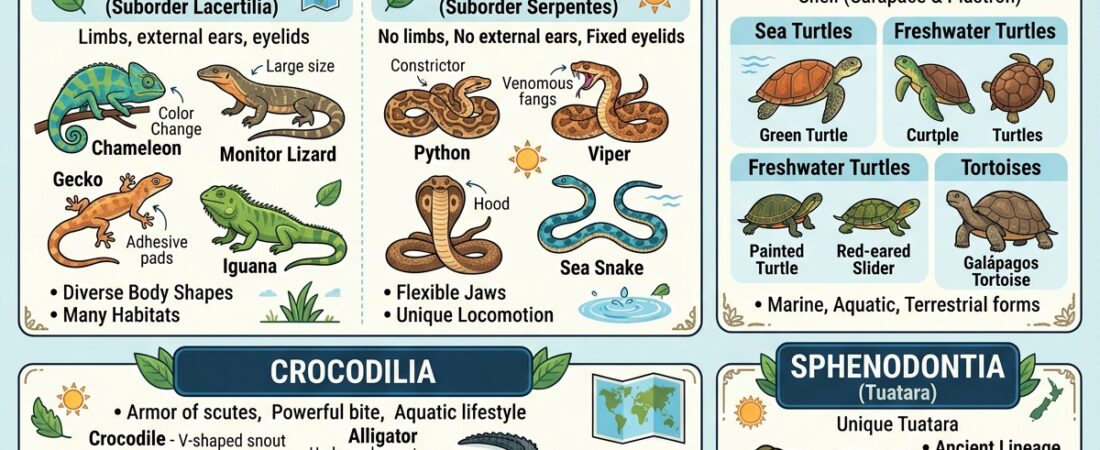
Reptiles are some of the most fascinating animals on Earth. They can be found in deserts, forests, wetlands, grasslands, oceans, and even urban environments. From tiny geckos hiding between rocks to huge crocodiles living in rivers, reptiles come in many shapes, sizes, colors, and behaviors.
The word reptile describes a broad group of animals that generally have scaly skin, breathe air through lungs, and are ectothermic, meaning they rely on external sources of heat to regulate their body temperature. There are thousands of reptile species around the world, and they are commonly divided into four major groups: snakes, lizards, turtles and tortoises, and crocodilians.
Understanding the different types of reptiles can help us appreciate their role in nature and learn more about their unique adaptations.
What Are Reptiles?
Reptiles are vertebrate animals belonging to the class Reptilia. Most reptiles have skin covered with scales or protective structures that help reduce water loss. Unlike mammals and birds, reptiles do not maintain a constant internal body temperature. Instead, they use their surroundings to warm or cool themselves.
Most reptiles lay eggs, although some species give birth to live young. They use lungs to breathe and have highly developed adaptations that allow them to survive in different environments.
Reptiles are found on almost every continent except Antarctica. Their remarkable ability to adapt has allowed them to survive in extremely hot deserts, tropical rainforests, freshwater habitats, and marine environments.
1. Snakes
Snakes are one of the most recognizable types of reptiles. There are thousands of snake species, ranging from tiny species that can fit in the palm of a hand to enormous snakes several meters long.
Unlike lizards, snakes do not have external legs. Their long bodies and flexible skeletons allow them to move through grass, sand, trees, and water. Some snakes use a side-to-side movement called lateral undulation, while others use specialized movements to climb or travel across loose surfaces.
Snakes have different diets depending on their species. Many eat rodents, birds, frogs, fish, eggs, insects, or other animals. They swallow their food whole because they cannot chew in the same way mammals do.
Some snakes are venomous, meaning they produce venom that can be delivered through specialized teeth. Others kill prey by constriction. However, most snake species are not dangerous to humans and generally avoid human contact.
Common examples include:
- Pythons
- Boas
- Cobras
- Vipers
- Rat snakes
- Corn snakes
- Garter snakes
- Sea snakes
Snakes play an important role in ecosystems because they help control populations of rodents, insects, and other animals.
2. Lizards
Lizards are another major group of reptiles. They are extremely diverse and can be found in deserts, forests, mountains, grasslands, and human environments.
Most lizards have four legs, although some species have reduced or completely absent limbs. They generally have movable eyelids and external ear openings, features that distinguish many lizards from snakes.
Lizards vary greatly in size. Some tiny geckos are only a few centimeters long, while monitor lizards can become very large.
Different lizards have different diets. Some mainly eat insects and other small animals, while others consume plants, fruits, or a combination of foods.
Popular examples of lizards include:
Geckos
Geckos are small to medium-sized lizards known for their climbing abilities. Many species have specialized toe pads that allow them to move across walls and other smooth surfaces.
Chameleons
Chameleons are famous for their independently moving eyes, long tongues, and ability to change color. Their color changes can be related to communication, temperature, mood, and camouflage.
Iguanas
Iguanas are generally plant-eating lizards. Many species spend considerable time in trees and are strong swimmers.
Monitor Lizards
Monitor lizards are intelligent and powerful reptiles. The group includes the Komodo dragon, the world’s largest living lizard.
Lizards contribute to ecosystems by controlling insect populations and serving as prey for larger animals.
3. Turtles
Turtles are reptiles recognized by their distinctive protective shells. The shell is part of their skeleton and provides protection from predators.
Turtles can live in freshwater, oceans, wetlands, and terrestrial environments. Their bodies are specially adapted to their surroundings.
Aquatic turtles often have streamlined shells and webbed feet or flippers that help them swim. Terrestrial turtles generally have sturdier legs designed for walking on land.
Some well-known turtles include:
- Green sea turtles
- Leatherback sea turtles
- Snapping turtles
- Painted turtles
- Box turtles
- Softshell turtles
Sea turtles spend most of their lives in the ocean but usually return to beaches to lay their eggs. Their life cycle can involve long migrations across large areas of the sea.
Turtles are important members of aquatic and terrestrial ecosystems. Some help maintain healthy aquatic environments, while others transport nutrients between different habitats.
4. Tortoises
Tortoises are closely related to turtles, but they are primarily land-dwelling reptiles. Their bodies are designed for life on land, with strong legs and feet that help them walk over different surfaces.
Most tortoises are herbivores and eat grasses, leaves, flowers, fruits, and other vegetation. Their slow metabolism and protective shells allow many species to survive for decades.
Some tortoises can live for more than 100 years under suitable conditions.
Examples include:
- Galápagos tortoise
- Aldabra giant tortoise
- Russian tortoise
- Sulcata tortoise
- Hermann’s tortoise
- Leopard tortoise
The Galápagos tortoise is particularly famous for its enormous size and long lifespan. Tortoises demonstrate how reptiles can develop specialized adaptations for dry and terrestrial environments.
5. Crocodilians
Crocodilians include crocodiles, alligators, caimans, and gharials. They are large, semi-aquatic reptiles that usually live in rivers, lakes, wetlands, and other bodies of water.
Crocodilians have powerful jaws, strong tails, muscular bodies, and excellent swimming abilities. They are predators and generally eat fish, birds, mammals, reptiles, and other animals depending on their size and species.
Crocodiles
Crocodiles are found in parts of Africa, Asia, Australia, and the Americas. Some species can survive in freshwater and saltwater environments.
Alligators
Alligators are closely related to crocodiles but have several physical differences. Their broader snouts and differences in tooth visibility can help distinguish them from many crocodile species.
Caimans
Caimans are generally smaller crocodilians found mainly in Central and South America.
Gharials
Gharials are specialized fish-eating crocodilians recognized by their extremely long, narrow snouts. They are strongly associated with river habitats.
Crocodilians are important apex or near-apex predators in many ecosystems. They can influence populations of fish and other animals and contribute to the balance of wetland environments.
6. Tuatara
The tuatara is a unique reptile found in New Zealand. Although it resembles a lizard, it belongs to a separate reptile lineage.
Tuatara have several unusual characteristics and are sometimes described as living representatives of an ancient reptile group. They have a distinctive structure on the top of their heads, often called a parietal eye, although it is not used like a normal functional eye.
Tuatara generally live in cool environments and can remain active at temperatures that would be challenging for many other reptiles.
They are an important example of reptile evolutionary history and show how ancient lineages can survive into the modern world.
Where Do Reptiles Live?
Reptiles have adapted to a wide variety of habitats. Different species can survive in environments with very different temperatures, humidity levels, and food sources.
Common reptile habitats include:
- Deserts
- Tropical rainforests
- Grasslands
- Mountains
- Rivers
- Lakes
- Swamps
- Coastal areas
- Oceans
- Agricultural areas
Desert reptiles often have adaptations that help them conserve water and survive high temperatures. Aquatic reptiles, meanwhile, may have streamlined bodies, webbed feet, or other features that help them move through water.
How Do Reptiles Survive?
Reptiles have developed many adaptations that help them survive. Their scales provide protection and reduce water loss. Their ectothermic nature also allows them to use environmental heat instead of producing large amounts of internal heat.
Many reptiles use camouflage to hide from predators or approach prey. Some have defensive behaviors, while others rely on speed, shells, venom, or powerful jaws.
Their reproductive strategies also vary. Many reptiles lay eggs in protected locations, while some species give birth to live young.
Why Are Reptiles Important?
Reptiles are an important part of healthy ecosystems. Predatory reptiles can control populations of rodents, insects, fish, and other animals. Herbivorous reptiles can influence vegetation and help move nutrients through ecosystems.
Reptiles are also important indicators of environmental health. Changes in their populations can provide information about habitat loss, pollution, climate conditions, and other environmental pressures.
Unfortunately, many reptile species face threats from habitat destruction, illegal wildlife trade, pollution, invasive species, road accidents, and climate change. Protecting natural habitats is therefore essential for their long-term survival.
Reptiles as Pets
Some reptiles are popular pets because they can be fascinating to observe and, depending on the species, may require less daily interaction than many traditional pets. Common pet reptiles include certain geckos, snakes, bearded dragons, and tortoises.
However, keeping a reptile is a serious responsibility. Different species have specific requirements for temperature, humidity, lighting, enclosure size, diet, and veterinary care. Anyone considering a reptile as a pet should research the species carefully and make sure it can be kept legally and responsibly.
Wild reptiles should generally be observed in their natural environments rather than captured.
Conclusion
Reptiles are an incredibly diverse group of animals with unique adaptations and behaviors. The major types include snakes, lizards, turtles, tortoises, and crocodilians, while unusual groups such as the tuatara demonstrate the ancient evolutionary history of reptiles.
From desert-dwelling lizards to ocean-going sea turtles and powerful crocodiles, reptiles occupy an impressive range of habitats. Each species has developed specialized features that help it find food, avoid predators, reproduce, and survive.
Learning about different types of reptiles is not only interesting but also helps us understand the importance of protecting wildlife and natural ecosystems. Whether they are large or small, dangerous or harmless, reptiles are valuable parts of the natural world and deserve careful study and conservation.